
3 Product Manager Skills required for landing a new role

Product managers need strength across five domains: technical, business, design, soft skills, and AI fluency. Of these, three skills carry the most hiring and performance signal right now: strategic thinking, clear communication, and metric-driven decision-making. Rather than trying to master everything at once, pick two or three skills and commit to a focused one- to three-month sprint.
1. The five core domains of product management competency
Most competency frameworks sort PM skills into five groups, and treating them as a map rather than a checklist makes it easier to plan what to learn next. Uxcel’s 2026 skill directory classifies 35 distinct PM competencies into these domains, noting that AI skills have moved from a nice-to-have into an expected capability for senior roles.
-
Technical: API literacy, system architecture awareness, and the ability to scope feasibility conversations with engineers.
-
Business: Market sizing, pricing logic, revenue modeling, and competitive positioning.
-
Design: UX literacy, interaction patterns, and the ability to critique a flow without redesigning it yourself.
-
Soft skills: Communication, influence, empathy, and negotiation.
-
AI: Prompt design, AI-assisted analytics, and evaluation frameworks for AI-driven features.
Each domain maps to a different part of daily work. Technical and design fluency shape how you collaborate with the people building the product. Business skills shape how you defend a roadmap to leadership. Soft skills determine whether people actually follow your lead when you have no formal authority over them, and AI fluency is increasingly what separates a mid-level PM from someone trusted with a flagship feature. Hiring panels tend to probe at least one skill from each domain, so a gap in any single area shows up quickly in interviews and in performance reviews.
2. Hard skills hiring managers expect from product managers
Hard skills are the easiest to evaluate in an interview, which is exactly why hiring managers lean on them. For practical guidance on measuring success and refining product outcomes, see Analytics for Content Marketing: Boosting SaaS Growth. The five that come up most consistently are data and metrics, technical fluency, experimentation, discovery and market analysis, and product writing.
-
Data and metrics: You should be able to pick the right success metric, explain why a metric moved, and read a cohort report without help. A good exercise is picking one feature in a live product and writing down the single metric you would use to judge whether it succeeded, then checking whether your company’s dashboard actually tracks it. Choosing one north star metric with two to three leading indicators keeps this focused instead of scattershot.
-
Technical fluency: You do not need to write production code, but you need enough grasp of APIs and system architecture to scope a feature honestly with engineering. Berkeley Haas frames this well: PMs operate as business and customer subject-matter experts first, using technical fluency as a collaboration tool rather than trying to out-engineer the engineers. Practice by sitting in on one architecture review a month and asking what would break if a dependency changed.
-
Experimentation: Designing a valid A/B test means defining a hypothesis, a sample size, and a success threshold before you launch, not after you see the results. For AI-driven features, this extends to eval design, which Uxcel and other 2026 competency guides now treat as a distinct and increasingly important skill for AI product roles.
-
Discovery and market analysis: Jobs-to-be-done interviews, competitive teardown, and the discipline of turning five qualitative conversations into one testable hypothesis. Run ten customer interviews on a single problem area and write one hypothesis statement at the end, not ten separate observations.
-
Product writing: A PRD earns its keep when it states success criteria and acceptance tests clearly enough that an engineer could build the feature without asking you three clarifying questions. Rewrite your last PRD by cutting it in half and see if anything important disappears.
Pro Tip: Pick one metric you don’t currently track, add it to a dashboard this week, and check it daily for a month before deciding if it matters.
3. Soft skills that separate good PMs from great ones
Hard skills get you shortlisted. Soft skills decide whether people trust your judgment once you’re in the room, and they’re what Stanford Online and other programs consistently flag as the differentiator between competent and exceptional PMs.
-
Communication: Tailor the same update differently for an executive (outcome first, risk second) and an engineer (constraint first, trade-off second); a structured narrative beats a long status update every time.
-
Influence without authority: You rarely manage the people you depend on, so trust gets built through transparency and consistent delivery rather than a title. Scope trade-offs honestly instead of overpromising, and the next negotiation gets easier.
-
Empathy and user insight: Empathy is widely ranked as a foundational soft skill because it helps PMs translate raw user pain points into strategy that both engineers and executives can act on. The practice is turning a vague complaint into a specific, testable hypothesis.
-
Adaptability and decisiveness: A hypothesis-driven mindset, act, measure, iterate, lets you move without waiting for certainty that will never arrive. Being comfortable with being proven wrong is, according to Stanford Online, one of the traits that most reliably separates senior PMs from the rest.
Pro Tip: After your next stakeholder meeting, rewrite your key message in one sentence for an executive and one sentence for an engineer, and notice how differently they read.

4. How to build PM skills: 90-day sprints and measurable experiments
Skill development works best as a curriculum, not a wish list. Uxcel’s 2026 guidance recommends choosing two to three skills, running a focused sprint of one to three months, and measuring the outcome instead of trying to absorb every competency at once.
-
Choose one skill from a domain where you have the biggest gap relative to your next role.
-
Set three measurable goals tied to artifacts, not vague intentions, such as “ship two A/B tests” or “write three PRDs that need zero follow-up questions.”
-
Run the experiments inside your actual job rather than in a side project, so the evidence is real.
-
Collect evidence, keeping an artifact portfolio of PRDs, experiment write-ups, and metrics like experiment velocity or feature adoption rate.
Micro-projects that fit neatly into a 90-day window:
-
Run one A/B test from hypothesis to readout, including a written postmortem.
-
Write a PRD for a real feature and follow it through to ship.
-
Conduct ten structured user interviews on a single problem and synthesize them into one hypothesis.
If you’re sequencing skills for the first time, a reasonable order is one communication skill, one technical skill, and one discovery skill, in that order, since each builds the foundation the next one needs.
5. Prioritizing skills by career stage
What to learn next depends heavily on where you sit. An aspiring PM, an individual contributor, and a senior PM are solving different problems, so the same skill does not carry the same urgency for all three.
-
Aspiring PMs: Prioritize communication, user research basics, and one analytics skill you can demonstrate in a portfolio or case study.
-
IC PMs: Focus on execution discipline, stakeholder management across multiple teams, and sharpening the craft skills (writing, prioritization frameworks) that make you reliable.
-
Senior PMs: Shift toward strategy, financial modeling, and mentoring, since influence at this level often means shaping how the whole organization thinks about a problem.
-
Quick checklist: Pick the skill your last performance review flagged, the one your next role description repeats twice, or the one that would unblock a project you’re stuck on today.
6. Practicing data and discovery skills with session replay and analytics
A practical way to build metric-driven decision-making and discovery skills at the same time is a four-step workflow that pairs quantitative data with qualitative replay.
-
Identify a metric gap, such as a conversion funnel step with an unexplained drop.
-
Inspect funnels and heatmaps to see where users hesitate or abandon the flow.
-
Replay individual sessions to see the actual friction a dashboard number can’t explain on its own.
-
Design a focused experiment based on what the replay revealed, not just the aggregate number.
Combining qualitative replay with quantitative funnel data sharpens both prioritization and hypothesis design, because you stop guessing why a number moved and start seeing it happen. Session replay, heatmaps, funnel analysis, and error tracking, paired with attention to privacy compliance, make this workflow operationally realistic for a product team. For a deeper walkthrough, LiveSession’s guide to analytics-focused PM work and its piece on UX analysis techniques both cover this in practice.
7. Prioritization and roadmap skills
Prioritization is where strategy meets constraint, and it’s a skill employers test for almost as often as communication. A PM who can’t say no clearly ends up with a roadmap that tries to please everyone and satisfies no one.
Frameworks like RICE, weighted scoring, and now-next-later each solve a different problem: RICE works well when you have decent data on reach and impact, while now-next-later works better for communicating sequencing to stakeholders who don’t need the underlying math. The skill isn’t memorizing a framework, it’s choosing the right one for the decision in front of you and being able to defend the trade-off you made. A roadmap is also a communication artifact as much as a planning one, so the same prioritization decision often needs two versions: one detailed enough for engineering, one simplified enough for an executive update. Practicing this means re-prioritizing a real backlog with two different frameworks and comparing what each one would have shipped first, which usually reveals your own hidden biases faster than any article can.

8. Why influence without authority is the most underrated PM skill
Most PMs have no direct authority over the engineers, designers, and stakeholders they depend on every day, which makes influence the skill that actually determines whether anything ships. It’s built through transparency and small, consistent wins rather than persuasion tactics, and it’s also the hardest skill to teach because it compounds slowly.
Three experiments worth trying this week: run a short alignment readout before a decision instead of after, make one piece of cross-team delivery visible to people outside your immediate circle, and write down a decision along with the trade-offs you rejected so others can see your reasoning, not just your conclusion.
Practicing these skills with LiveSession’s analytics tools
We built an analytics platform for product teams to turn the workflow described above into a daily habit rather than a quarterly exercise. Such platforms typically combine session replay, heatmaps, funnel analysis, and error tracking in one dashboard, with privacy compliance and integrations with popular tools.
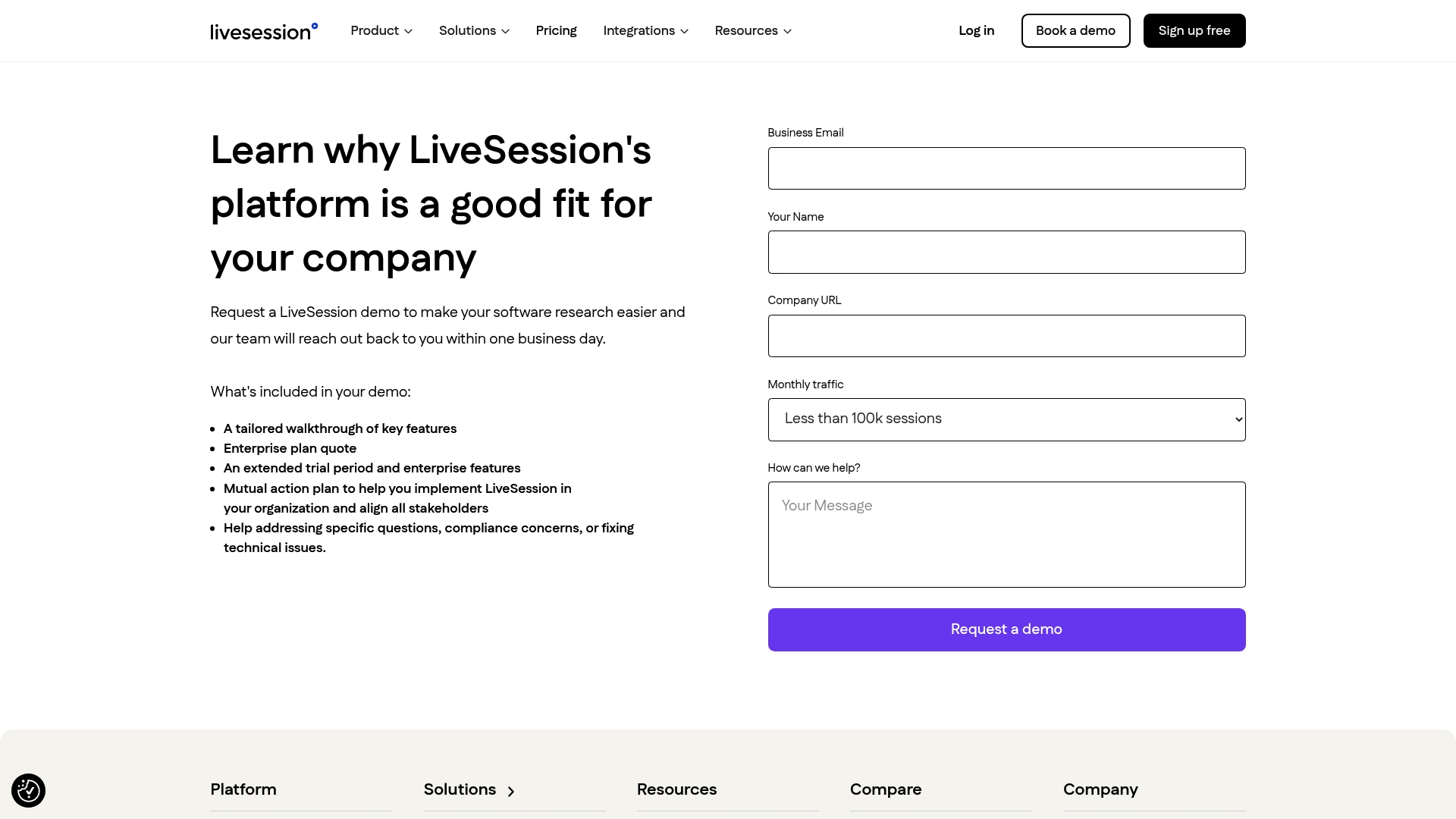
A simple way to use it inside a 90-day sprint: find a funnel step with an unexplained drop, replay the sessions around it to see what users actually hit, then design one experiment based on what you saw. Our clickmap tools make the heatmap side of that workflow fast to set up, and our product analytics dashboard keeps the funnel data in view while you work. Our plans range from a Free tier up to Pro at $83 per year, so you can start this workflow on a real product without a long commitment.
FAQ
What skills does a product manager need?
A product manager needs strength across five domains: technical, business, design, soft skills, and AI fluency, with strategic thinking, clear communication, and metric-driven decision-making ranking as the highest-signal skills for hiring in 2026. Most frameworks recommend building two or three of these at a time rather than all at once.
What are the five P’s of product management?
Definitions of the “five P’s” vary across sources and aren’t a standardized industry framework, so treat any specific list with some caution. A more reliable reference point is the five-domain competency model, which groups skills into technical, business, design, soft, and AI categories.
What are the core competencies of a product manager?
Core competencies typically include strategic thinking, communication, data literacy, technical fluency, user research, and influence without authority. Competency directories consistently rank strategic thinking and metric-driven decision-making among the top hiring signals.
What are the three key skills required for a product owner?
A product owner role overlaps heavily with product management but tends to emphasize backlog prioritization, clear acceptance criteria writing, and close collaboration with engineering teams. These map closely to the prioritization, product writing, and technical fluency skills covered earlier in this guide.
How long does it take to build a new PM skill?
A focused sprint of one to three months is a common structure for developing one or two PM skills with measurable evidence, such as shipped experiments or completed PRDs. Structured, sequenced practice tends to produce faster, more visible progress than trying to improve everything simultaneously.
Sources
Related articles

Get Started for Free
Join thousands of product people, building products with a sleek combination of qualitative and quantitative data.