
Getting More Insights About Your Audience: A Guide

Knowing your audience isn't about demographics on a spreadsheet. Age ranges, job titles, and geographic data tell you who your customers are on paper, but they tell you almost nothing about what drives their decisions, what keeps them up at night, and what makes them choose you over the dozens of alternatives competing for their attention. Most businesses collect data. Far fewer actually turn that data into actionable understanding. Here's how to close that gap.
Start with what you already have
Before you invest in new tools, surveys, or research initiatives, mine the data you're already sitting on. Your CRM has conversion patterns and deal histories. Google Analytics has behavioural data about how people navigate your site. Support tickets reveal what confuses or frustrates your users. Sales call recordings capture objections and hesitations in your prospects' own words. Social media comments show what resonates and what falls flat.
Look for patterns rather than individual data points. Which blog posts get the most time on page (not just the most visits—time on page indicates genuine engagement)? What questions come up repeatedly in support tickets? What objections does your sales team hear most often, and at which stage of the conversation? Which features do people ask about before purchasing? Which email campaigns get forwarded?
This is audience research with zero additional cost. The data already exists; it just needs someone to look at it with the right questions in mind. Set aside half a day to dig through your existing data before spending a penny on new research.
Talk to real customers
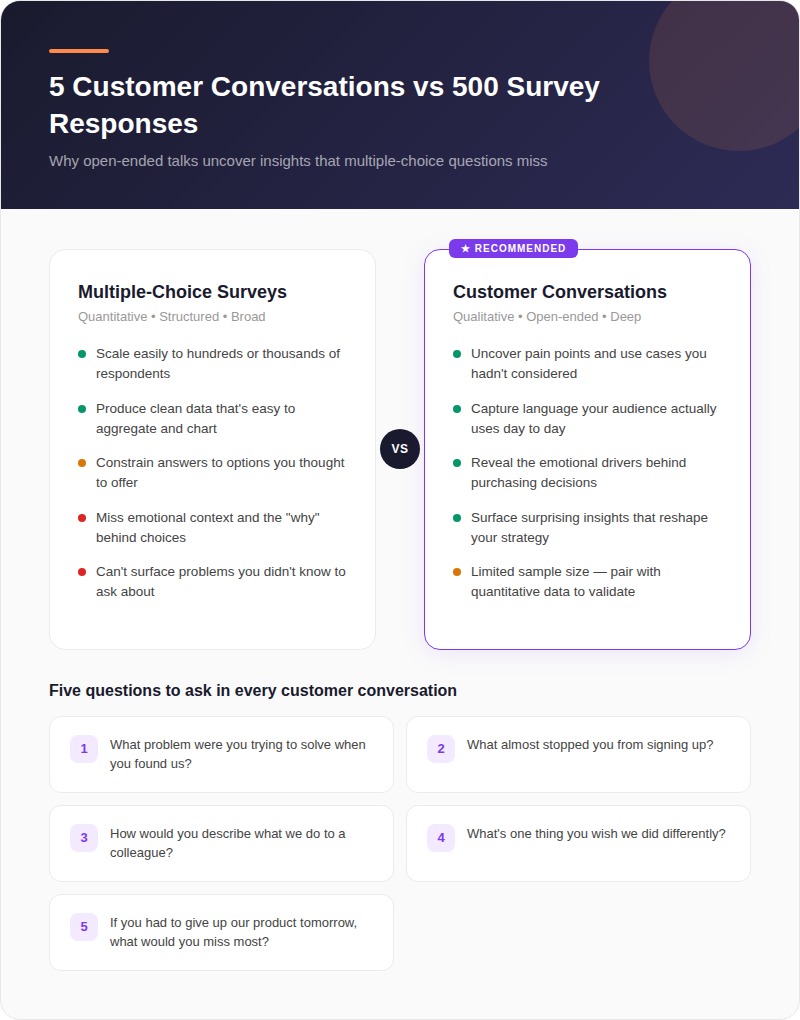
Surveys are useful but limited. Multiple-choice questions give you quantitative data, but they constrain people to the answers you thought to offer. The insights that change your strategy usually come from things you didn't think to ask about.
Schedule 15–20 minute calls with a handful of customers—both happy ones and ones who nearly churned or had a rocky experience. Use open-ended questions that let them tell their story rather than answer your checklist. Good starting questions include: What problem were you trying to solve when you found us? What almost stopped you from signing up? How would you describe what we do to a colleague? What's one thing you wish we did differently? If you had to give up our product tomorrow, what would you miss most?
Five good customer conversations will teach you more than a 500-response survey with multiple-choice answers. You'll hear language you've never thought to use in your marketing. You'll discover pain points you didn't know existed. You'll understand the emotional context behind purchasing decisions that no analytics dashboard can capture. In platform businesses, these behavioural patterns often compound through network effects, where every additional user or contributor increases the value of the product for the rest of the community.
Record these calls (with permission), transcribe them, and highlight quotes that surprise you. Those surprises are where the real insights live.
Analyse your search console data
Google Search Console shows you the exact queries people use to find your site. These aren't just SEO keywords—they're windows into your audience's intent, vocabulary, and stage in their buying journey. If you're also tracking how your brand appears in AI search results with a ChatGPT rank tracker, comparing those queries can reveal where traditional SEO and AI discovery overlap.
If people are finding your pricing page by searching "[your brand] vs [competitor]," that tells you they're in active comparison mode and your pricing page should address competitive positioning directly. If they're searching "how to [solve a problem]," they're in learning mode and might not be ready to buy yet—but they're discovering you through educational content, which means your blog strategy is working.
Look for query clusters that reveal unmet needs. If dozens of people are searching for "[your product] + [feature you don't have]," that's either a product development opportunity or a content gap you need to address. If people are searching for "[your product] + tutorial" or "[your product] + how to," your onboarding or documentation might need improvement.
Map these queries to stages of the buyer journey (awareness, consideration, decision) and you'll see where your content is serving well and where there are gaps worth filling.
Use social listening
Your audience is talking about their problems, preferences, and opinions on social media, forums, and review sites—whether or not they're tagging you. These unfiltered conversations are some of the most honest audience data you can find because people aren't performing for you or answering your questions. They're talking to each other.
Tools like Brand24, SparkToro, or even manual monitoring of relevant subreddits, LinkedIn groups, industry Slack communities, and review platforms like G2 or Capterra can reveal what your audience cares about in their own words.
Pay special attention to the language they use. It's often different from the language on your website, and matching it improves everything from ad copy to cold email subject lines to feature naming. If your customers call something a "dashboard" and you call it a "command centre," you're creating unnecessary friction. Use their words, not yours.
Also monitor conversations about your competitors. What do their users praise? What do they complain about? Those data points tell you where the market's expectations are and where opportunities exist for differentiation.
Segment instead of averaging
Your "average customer" probably doesn't exist. When you average across your entire customer base, you get a fictional composite that doesn't accurately represent any real segment's needs, behaviours, or preferences.
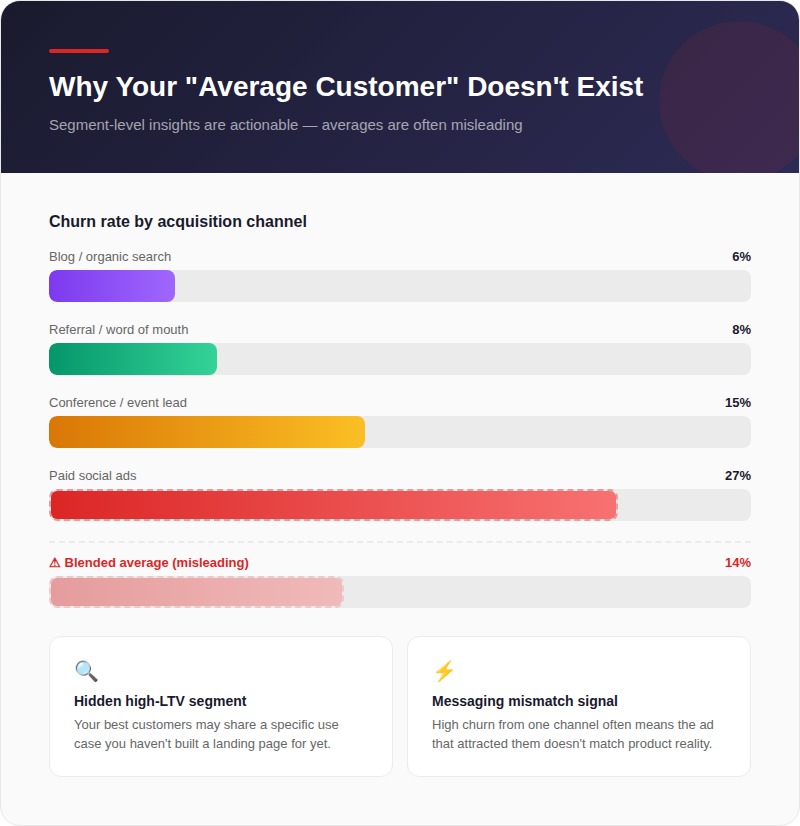
Audience insights become much more useful when you segment: by company size, by use case, by acquisition channel, by engagement level, by plan tier, by geography. The behaviour and needs of a startup that signed up through a blog post are fundamentally different from those of an enterprise lead that came from a conference. Treating them the same in your marketing, onboarding, and product development means serving neither well.
Segment your data and look for insights within each group. Platforms such as CRM for eCommerce make this process easier by organizing customer interactions, order history, and lifecycle data into clear segments that marketing and sales teams can analyze. For example, certain Salesforce deployments. You might discover that your highest-LTV customers all share a specific use case you haven't built a landing page for. Or that customers from one acquisition channel churn at twice the rate of others, suggesting a messaging mismatch between the ad that attracted them and the reality of your product.
What works for one segment might actively repel another. Insights at the segment level are actionable; insights at the average level are often misleading.
Run targeted micro-surveys
You don't need a long annual survey that takes twenty minutes to complete and produces a 50-page report nobody reads. Short, targeted surveys triggered at specific moments yield higher response rates and more relevant data because they're contextual—they ask about an experience the person just had, not a vague recollection from months ago.
Good trigger points include:
- immediately after onboarding (what was confusing? what was missing?),
- after a purchase (what convinced you to buy? what almost stopped you?),
- when someone cancels or downgrades (what's the primary reason you're leaving?),
- after a support interaction (was your issue resolved? how was the experience?),
- and after a milestone (you've been with us for six months—what would you improve?).
Similar approaches are widely used internally by organisations through employee feedback tools to capture timely insights at important moments in the employee journey. For example, to ask about preferred benefits options such as phantom stock agreements.
Keep them to two or three questions maximum. One open-ended question (like "What's the one thing we could improve?") often produces more actionable insight than ten scaled questions where everyone circles 4 out of 5 and you learn nothing useful.
Study your competitors' audiences
Your competitors' reviews, social media comments, support forums, and community discussions reveal what their audiences value, what frustrates them, and where they feel underserved. This is public data that most companies never bother to analyse systematically.
Read their G2 and Capterra reviews. What do their one-star reviews complain about? What do their five-star reviews praise? Look at the comments on their LinkedIn posts and blog articles. Join their communities (if they're public) and observe the conversations. What are their users struggling with? What workarounds have they built? What are they wishing for?
If a competitor consistently gets complaints about poor customer support, that's an opportunity for you to emphasise yours. If their users love a specific feature but wish it worked differently, that's a product insight. If their audience uses specific language to describe their problems, that language should inform your own messaging.
This isn't about copying their strategy. It's about understanding the broader market's needs and finding the angles they're underserving.
Build audience personas from data, not assumptions
Personas are useful when they're built from real data and grounded in actual customer behaviour. They're worse than useless when they're fictional narratives dreamed up in a workshop by people who haven't talked to a customer in months.
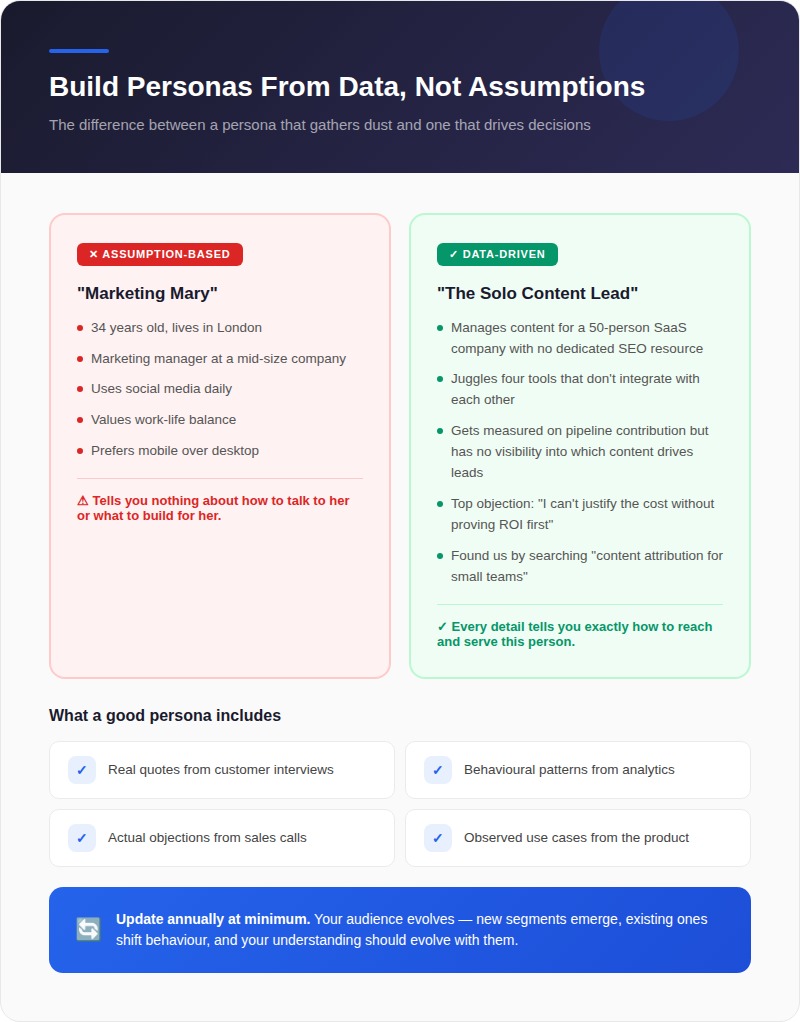
Good personas include real quotes from customer interviews, not invented ones. Real behavioural patterns from analytics, not assumed ones. Real objections from sales calls, not guesses. Real use cases observed in the product, not imagined workflows.
Give each persona a specific context rather than a demographic profile. "Sarah is a 34-year-old marketing manager" tells you nothing useful. "Sarah manages content for a 50-person SaaS company with no dedicated SEO resource, juggles four tools that don't integrate, and gets measured on pipeline contribution but has no visibility into which content actually drives leads" tells you exactly how to talk to her and what to build for her.
Update your personas at least annually. Your audience evolves—their needs change, new segments emerge, existing segments shift behaviour—and your understanding should evolve with them.
Use session replays to see what your analytics can't tell you
Quantitative data tells you what happened — which pages people visited, where they dropped off, how long they stayed. But it rarely tells you why. A user landing on your pricing page and leaving after eight seconds is a data point. Watching the recording of that session and seeing them scroll past your feature comparison table, hover over the enterprise tier, then close the tab is an insight.
Session replay tools reconstruct individual user journeys so you can observe real interactions rather than interpret aggregated metrics. You see exactly where someone hesitated, rage-clicked, got stuck in a loop, or abandoned a flow. For audience research, this is invaluable — it closes the gap between what your analytics dashboard reports and what actually happened on screen.
LiveSession is a product analytics platform that combines qualitative and quantitative data in a single interface.
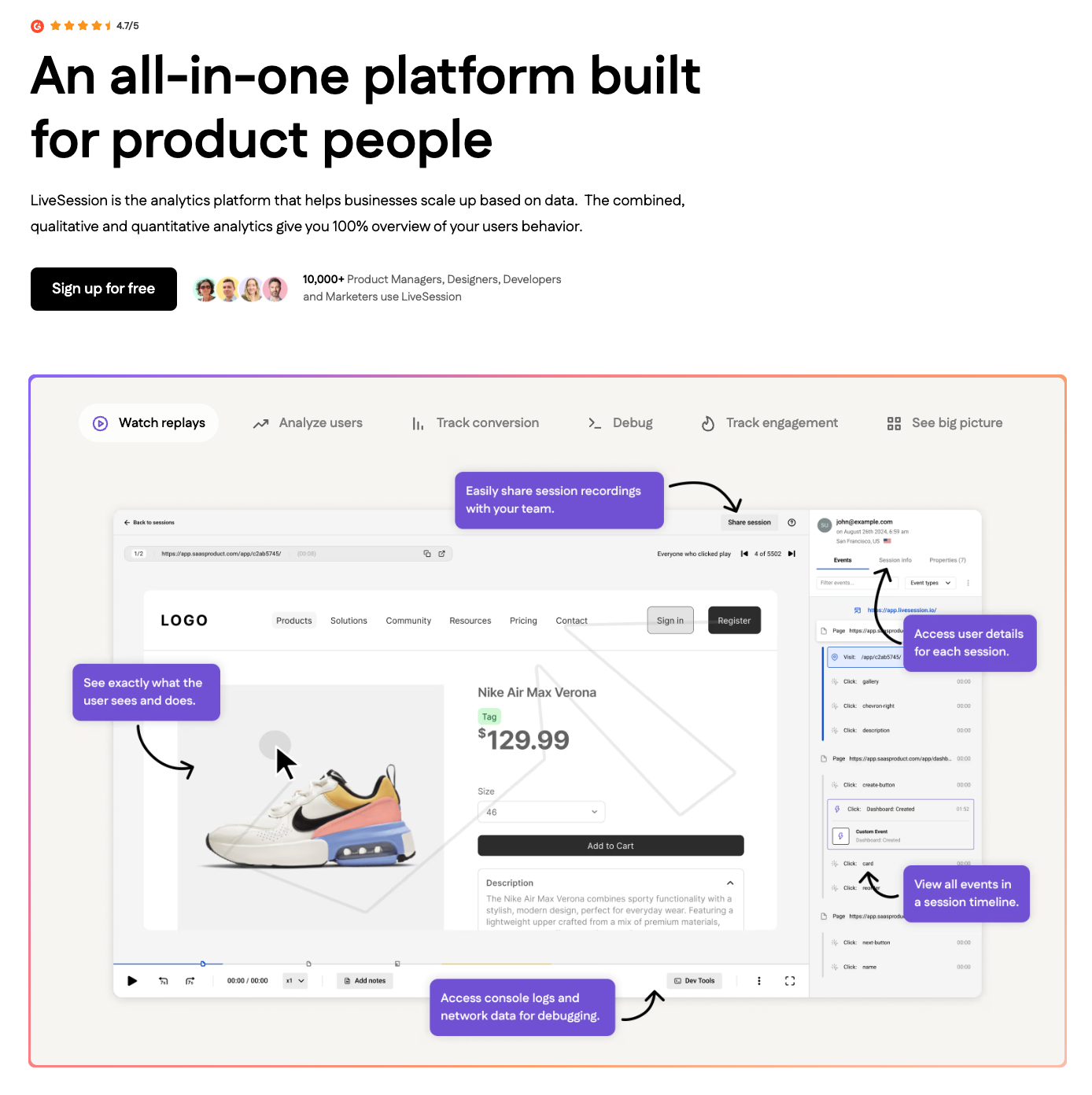
Its core capabilities include session recordings that capture mouse movements, clicks, scrolls, and navigation paths, alongside product analytics features such as custom dashboards, conversion funnels, heatmaps, and event-based tracking for metrics like feature adoption and daily active users. What makes it particularly useful for audience research is how it connects the two layers: you can define a segment — say, users from a specific acquisition channel who reached a particular funnel step — and then watch the session recordings of that exact cohort to understand why they behaved the way they did.
For development and support teams, LiveSession also surfaces console logs, JavaScript errors, and network requests alongside each recording, making it easier to distinguish UX friction from outright bugs. And because it's built by a team based in Poland, with data stored on EU infrastructure, it's designed around GDPR and CCPA compliance from the ground up — with built-in sensitive data anonymisation and privacy controls that let you mask content before it's ever recorded.
The broader point: traditional analytics platforms give you maps of user behaviour. Session replays give you the street-level view. If you're serious about understanding your audience beyond what Google Analytics can surface, pairing quantitative metrics with qualitative session data is one of the highest-leverage moves you can make.
Analyse referral behaviour for deeper customer insights
One of the most revealing signals about your audience is who recommends you to others—and why. When customers actively refer friends or colleagues, they’re effectively telling you what they value most about your product.
Referral data can uncover patterns that traditional analytics often miss. For example, you might discover that customers who use a particular feature are significantly more likely to refer others, or that referrals cluster around a specific industry, use case, or customer segment. These signals often highlight your product’s strongest value proposition in the real world.
Referral platforms like ReferralCandy allow businesses to track referral activity and see which customers are driving word-of-mouth growth. By analysing who refers others, when they do it, and what incentives motivate them, you gain a clearer picture of your most enthusiastic users.
This insight can influence everything from messaging to product development. If your most active referrers consistently highlight a specific benefit—faster workflows, cost savings, ease of use—that language should appear prominently in your marketing. Referral behaviour doesn’t just generate new customers; it reveals what your best customers believe is worth sharing.
Looking at referral data alongside your other audience research helps you understand not just who your customers are, but who your strongest advocates are—and why they’re motivated to spread the word.
Close the loop: act on what you learn
Audience insights are only valuable if they change what you do.
This sounds obvious, but the gap between "we learned something interesting about our audience" and "we changed our approach based on what we learned" is where most companies stall.
Value needs to be visible before commitment. Users are less willing to “click and find out” than they used to be. If the benefit of taking the next step isn’t upfront, they won’t take it. This is especially true for actions that feel promotional or self-serving. Referral programs illustrate this well — when the value exchange is clearly presented early (e.g., rewards for sharing), engagement increases. Tools like ReferralCandy help surface that value in a structured way, making the next step feel worthwhile rather than speculative.
Adjust your messaging based on the language your customers actually use, not the language your marketing team invented. Prioritise content topics based on what your audience is searching for, not what your team thinks is interesting. Address objections you hear in sales calls directly on your website, in your onboarding emails, and in your nurture sequences. Build features that your highest-value segments actually ask for, not features that sound impressive in a press release.
The translation from identified friction to implemented solution is where many teams get stuck — not because they don't know what to fix, but because friction fixes often require cross-functional coordination and don't fit neatly into product sprint priorities. This is where mobile development consulting becomes especially valuable, helping teams turn UX findings into practical product improvements without losing momentum in delivery.
The goal isn't to accumulate data or produce research reports. It's to make better decisions faster—about what to build, what to write, how to sell, and where to invest—because you genuinely understand the people you're trying to reach.
Every insight that doesn't lead to an action is just trivia.
Related articles



Get Started for Free
Join thousands of product people, building products with a sleek combination of qualitative and quantitative data.