
What Is a Product Manager? A Clear Definition and Guide

A product manager is the person who owns a product’s strategy and results, translating what users need and what the business needs into a single roadmap everyone can build against. That is the whole job in one sentence, but the role stretches wider than most job postings admit. A PM typically touches four things: market research, prioritization, cross-team alignment, and outcome tracking. According to Wikipedia, a product manager holds a strategic role responsible for a product’s development across its full lifecycle, not just the launch moment everyone remembers.
What a PM typically owns:
-
The product vision and multi-quarter strategy
-
The roadmap and prioritization decisions
-
Alignment between engineering, design, sales, and support
-
The metrics that prove a feature actually worked
Define Product Manager: Scope Across the Product Lifecycle
Product management covers five overlapping stages: discovery, definition, delivery, growth, and retirement. A PM doesn’t disappear once code ships. They stay attached to a feature through adoption, iteration, and eventually the decision to sunset it. Coursera frames the job around market research, prioritization, and vision setting rather than the mechanics of building.
The boundary that trips people up is where the PM stops and engineering starts. A PM defines the problem and the success criteria; engineers own how the solution gets built. Cross that line too often in either direction and you get either a PM who is micromanaging code or an engineering team building without direction.
The role also scales with the company:
-
At an early-stage startup, one PM might handle strategy, user research, and QA sign-off personally.
-
At a mid-size company, PMs specialize by product line and lean on dedicated researchers and analysts.
-
At a large enterprise, you’ll see technical PMs, growth PMs, and platform PMs, each owning a narrow slice of a much bigger system.
What Does a Product Manager Do Day to Day?
Ask ten hiring managers “what does a product manager do” and you’ll get ten slightly different answers, but the core checklist rarely changes. Every PM role, regardless of industry, tends to include these functions.
-
Running market and competitive research to spot gaps worth building for
-
Setting product strategy and maintaining the roadmap
-
Prioritizing what gets built next, usually against limited engineering capacity
-
Aligning stakeholders across sales, support, design, and leadership
-
Defining and tracking KPIs tied to business outcomes
-
Turning raw customer feedback into written requirements engineers can act on
-
Planning releases and coordinating go-to-market timing
Atlassian describes product management as sitting at the intersection of business, design, and technology, which is why the job pulls in so many directions at once.
Just as important is what a PM does not own. They generally do not manage daily developer tasks, write code, run sprint ceremonies alone, or make final design decisions. Those responsibilities usually sit with engineering leads, product owners, or design leads. Confusing the two is one of the most common mistakes people make about the role.
Pro Tip: In your first 30 days on a new PM role, produce two things: a one-page strategy doc and a prioritized backlog. Both force you to talk to stakeholders early, and both give the team something concrete to react to instead of guessing at your priorities.
What Skills and Backgrounds Lead to Product Management?
There’s no single degree that qualifies someone for this job, and that’s part of the appeal. Common entry points include computer science, business, and design degrees, plus bootcamps and lateral moves from engineering, marketing, or customer support. Edgewood Online points to data analysis, prioritization, stakeholder management, and synthesizing feedback as the core skills employers look for.
Hard skills matter, but soft skills often decide whether a PM survives the role. Influence without formal authority is the single most cited trait among experienced practitioners, since PMs rarely have direct reports and have to earn cooperation from engineering and design instead of ordering it.
-
Hard skills: data literacy, roadmapping, writing clear requirements, basic analytics fluency
-
Soft skills: stakeholder communication, negotiation, and the patience to say “not now” repeatedly
-
Learning resources: books on prioritization and product thinking, like these product management reads, build vocabulary fast
-
Alternative paths: freelance and contract work, tracked well by communities like The Freelance PM Club, give people a way in without a traditional title
Career progression usually runs associate PM, PM, senior PM, group PM or director, then VP of product. Each jump typically takes two to four years and hinges less on tenure than on whether you can point to a shipped outcome that moved a real business number.
Product Manager vs. Product Owner vs. Project Manager
These three titles get used interchangeably in job postings, which is exactly why the confusion persists. The cleanest way to separate them is by time horizon: PMs answer “what and why,” Product Owners answer “how and when,” and Project Managers answer “is it on schedule.”
| Role | Primary focus | Typical output |
|---|---|---|
| Product Manager | Strategy, market fit, long-term vision | Roadmap, product strategy doc |
| Product Owner | Backlog refinement, sprint priorities | Prioritized sprint backlog |
| Project Manager | Timeline, resource coordination, delivery | Project schedule, status reports |
PMI draws this line explicitly: PMs focus on long-term vision and market trends, while Product Owners handle day-to-day delivery and backlog grooming. Smaller companies often merge PM and Product Owner into one person simply because there isn’t enough work to split. Larger organizations separate them so the PM can stay focused on strategy instead of getting pulled into daily standups. A concrete example: a PM decides the company should build a referral program to lift signups; the Product Owner breaks that into sprint-sized tickets; the Project Manager makes sure design, engineering, and legal review hit their dates.
How Do Product Managers Structure Their Week?
No two PM calendars look identical, but certain rituals show up almost everywhere: user interviews, roadmap reviews, sprint planning check-ins, and writing product requirement documents (PRDs) that engineering can build from without guessing.
The more interesting skill is how PMs blend qualitative and quantitative signals into a single decision. Session replay tools show exactly where a user hesitated or rage-clicked; funnel metrics show how many people dropped off at that same step. Neither number tells the full story alone.
-
Watch a handful of session replays tied to a problematic step in onboarding.
-
Cross-check that qualitative pattern against funnel drop-off data for the same step.
-
Write a hypothesis, ship a small test, and measure the result against a single target metric.
A workable weekly cadence looks like: one block for user research or replay review, one block for stakeholder syncs, one block for roadmap or requirements writing, and the rest kept open for the fires that inevitably show up. Guides on prioritizing features are worth revisiting whenever the backlog starts feeling arbitrary.
Which Metrics Should a Product Manager Track?
The wrong metric will send an entire team chasing the wrong goal for a quarter. Activation measures whether a new user reaches a meaningful first outcome. Retention tracks whether they come back. DAU and MAU (daily and monthly active users) show usage density, conversion rate shows how many users complete a target action, and NPS gauges sentiment. LiveSession notes that DAU, MAU, and WAU are among the most common engagement measures PMs use to track product health.

Metric callout: A high DAU/MAU ratio signals a “sticky” product people return to daily, while a low ratio often means people use it occasionally and forget about it in between.
Pick one primary metric tied directly to a business goal, not five that all sound impressive. Vanity metrics, like total signups with no activation attached, feel good in a slide deck and mean almost nothing on their own. Validate any metric-driven hypothesis with a second signal, ideally a qualitative one, before declaring victory.
What Do Real Product Manager Projects Look Like?
Abstract responsibilities get easier to grasp with three quick scenarios.
-
Feature discovery: Users abandon a multi-step checkout. The PM runs interviews, spots a confusing address field, and simplifies it. Success is measured by checkout completion rate.
-
Onboarding improvement: Hypothesis: a shorter setup wizard raises activation. The PM ships an A/B test cutting five steps to three and tracks activation rate as the deciding metric.
-
Revenue experiment: Objective: lift upgrade conversion. The PM coordinates design, engineering, and marketing on a pricing page test, then measures the lift against baseline conversion.
How LiveSession Supports Product Manager Decisions
PMs increasingly lean on session-level tools to answer questions surveys can’t. During discovery, replaying real sessions on a confusing flow shows exactly where a user got stuck, without waiting weeks for interview scheduling. Post-launch, the same replays help confirm whether a bug report from support matches what actually happened on screen.
-
Session replay pinpoints friction points that funnel data alone can’t explain
-
Heatmaps and conversion funnels validate whether a fix actually changed behavior
-
GDPR and CCPA-compliant data handling matters for any PM working with regulated markets
| Signal type | Example use | Tool feature |
|---|---|---|
| Qualitative | Watching where users hesitate at checkout | Session replay |
| Quantitative | Measuring drop-off rate at each funnel step | Conversion funnels |
| Behavioral | Spotting rage clicks or repeated errors | Error tracking |
Deeper reading on applying these signals lives in LiveSession’s guide to product usage analytics.

Why Product Managers Matter to Successful Products
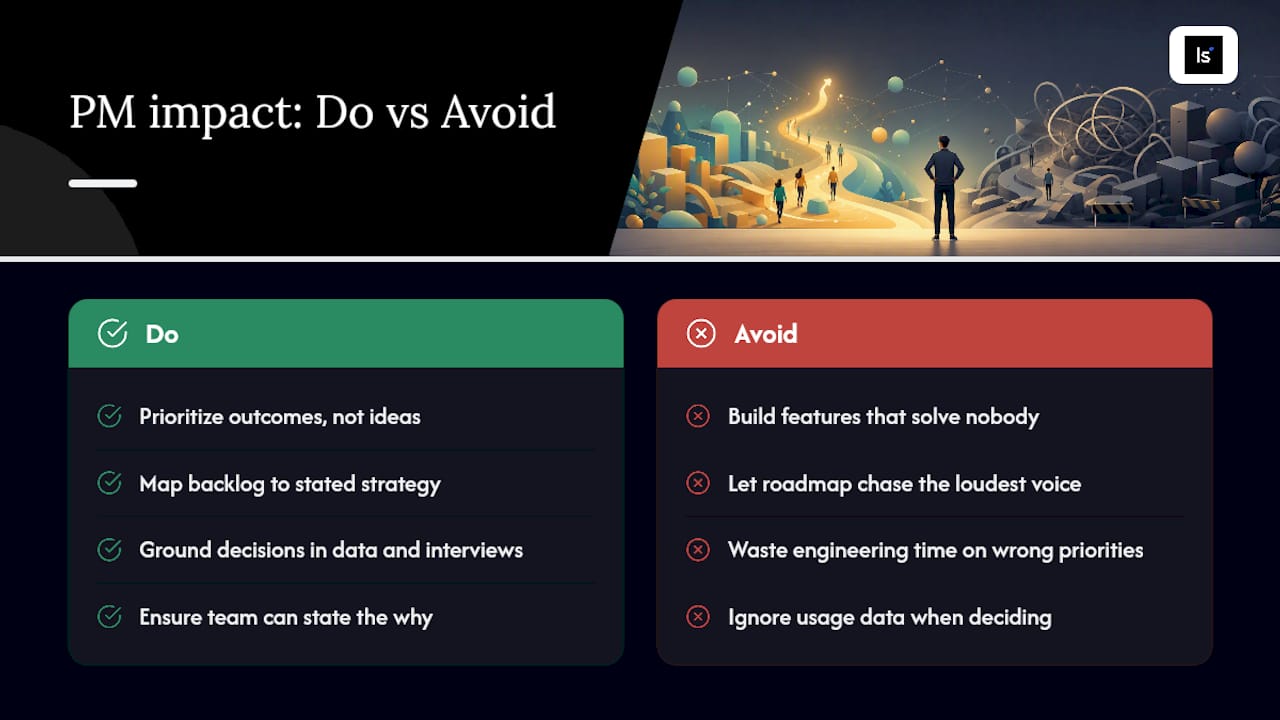
Products that succeed rarely do so by accident. Someone had to decide which problem was worth solving before a single line of code got written, and that decision usually sits with a PM. Companies without a clear product owner tend to build features that sound good in a meeting but solve nobody’s actual problem, because no one was accountable for connecting the build to a measurable outcome.
The PM’s real value shows up in the decisions that never get made publicly: the feature that got cut because usage data didn’t support it, the roadmap item that got reprioritized after three customer calls revealed a bigger pain point, the launch that got delayed a week because session replays showed a broken flow nobody caught in QA. None of that shows up in a press release, but it’s the difference between a product that compounds in value and one that slowly accumulates unused features nobody remembers building.
Weak product management doesn’t usually kill a company outright. It shows up as slow decay, wasted engineering time on the wrong priorities, a roadmap that shifts every quarter based on whoever complained loudest, and metrics that plateau because nobody owns the story behind the numbers. Strong PMs create the opposite pattern: a backlog that maps to a stated strategy, decisions grounded in both interviews and data, and a team that can explain, in one sentence, why they’re building what they’re building right now.
A New PM’s First Habit Worth Building
Block 30 minutes each week for session replay review and another 30 for a metrics check. That single habit keeps decisions evidence-based instead of opinion-based. Credibility with engineering and design comes from showing your work, not your title. Start with prioritization frameworks and a qualitative research guide for your next two reads.
— Tymek
See Session-Level Evidence Behind Every Product Decision
Livesession gives product managers something most research methods can’t: an unedited replay of what a user actually did, matched against the funnel data that shows where they dropped off. That combination shortens discovery from weeks of interview scheduling to an afternoon of watching real sessions.
If you’ve been prioritizing features off gut feeling or a spreadsheet full of assumptions, this is the faster route. Livesession pairs session replay with heatmaps, conversion funnels, and error tracking, all built to plug into workflows PMs already run through Intercom, Zendesk, or Segment. Try the Livesession demo to see how a real onboarding flow looks when you can watch exactly where users hesitate, then decide what to fix first.
Sources
Related articles


Get Started for Free
Join thousands of product people, building products with a sleek combination of qualitative and quantitative data.