
What Does a Product Manager Actually Do All Day?

A product manager owns the product’s vision and outcomes, balancing user needs, business goals, and technical feasibility at every decision point. That balancing act plays out across roadmap calls, stakeholder debates, and constant tradeoffs between what customers want and what engineering can ship. A product manager defines product strategy, roadmap, and features while making sure none of those three forces overrides the other two.
Success rarely shows up as a single number. PMs know they’re doing the job well when a few signals line up at once:
-
Activation or retention metrics move in the right direction after a launch.
-
Engineers and designers can explain why a feature matters, not just what it does.
-
Customer complaints about a known pain point drop after a fix ships.
-
Leadership trusts the roadmap enough to stop asking for justification every sprint.
What Does the Product Manager Do Day to Day?
The job splits into a handful of recurring responsibilities that repeat every cycle, whether the cycle is two weeks or two quarters. Understanding these responsibilities matters more than memorizing a job description, because the actual daily mix shifts by company and product stage.
-
Set vision and strategy. PMs translate a company’s business goals, more revenue, more retention, market expansion, into a specific product direction that a team can act on.
-
Own the roadmap and prioritization. Someone has to decide what gets built next and what gets cut, and that call sits with the PM more than anyone else.
-
Lead product discovery. Before committing engineering time, PMs test whether a problem is real and whether a proposed solution actually solves it.
-
Align cross-functional stakeholders. Engineering, design, sales, support, and leadership all want different things from the same roadmap, and PMs broker the compromise.
-
Plan launches and measure results. A PM’s job doesn’t end at ship date. It ends when the data shows whether the feature worked.
-
Manage the business case. For most feature bets, someone needs to estimate cost, projected impact, and payback, and that’s usually the PM’s spreadsheet.
Pragmatic Institute frames this well: PMs blend market insight with business strategy across the entire lifecycle, from the earliest idea through post-launch optimization. That’s a wider scope than most job titles suggest, and it’s why the role attracts people from engineering, design, and even sales backgrounds.
Pro Tip: Before agreeing to build anything, ask “what happens if we don’t build this?” If the answer is “nothing changes,” that’s a signal the problem isn’t urgent enough to earn a roadmap slot.
What Does a Day in the Life of a PM Look Like?
No two PM calendars look identical, but a realistic week includes a predictable rhythm of syncs, deep work, and customer contact.
A typical day might include a metrics dashboard check first thing, a stand up with engineering, a stakeholder sync with sales or support about a recurring complaint, and one or two blocks reserved for writing specs or reviewing user research. Fridays often trend toward retrospectives and roadmap grooming rather than new commitments.
Weekly rituals tend to include:
-
A roadmap review with leadership or peer PMs to check priorities against new data.
-
Sprint planning with engineering to size upcoming work.
-
At least one or two customer interviews or support ticket reviews to stay close to real usage.
-
A metrics review looking at the past week’s activation, retention, or conversion trends.
Most PMs split their time unevenly between discovery, figuring out what to build, and delivery, shepherding what’s already been decided through engineering. Early-stage products lean toward more discovery; mature products lean toward delivery and optimization. The recurring complaint from experienced PMs is that meetings crowd out the deep work discovery actually requires, so protecting even a two-hour uninterrupted block, calendar-blocked and defended, tends to separate PMs who ship thoughtful work from those who just react to the loudest voice in the room.
What Skills Does a Product Manager Need?
Hiring managers look for a specific blend, and it’s rarely just technical skill or just charisma. It’s both, plus a research habit most job seekers underestimate.
-
Problem discovery and user research. Knowing how to run an interview without leading the customer toward the answer you want.
-
Prioritization frameworks. RICE, MoSCoW, or a simpler cost-versus-impact grid, whatever gets a defensible ranking on paper instead of gut feel.
-
Data literacy. Reading a funnel, understanding what an A/B test result actually proves, and knowing when a metric move is noise.
-
Communication. Writing a requirements doc that an engineer can build from without six follow-up questions.
-
Business acumen. Connecting a feature decision back to revenue, retention, or cost, not just user delight.
Coursera’s overview of the role notes that PMs lean on market research and data analysis together, not one or the other, to make lifecycle decisions. One caution worth internalizing early: the “CEO of the product” framing gets thrown around a lot in job postings and onboarding decks, but that metaphor misleads more than it helps, since PMs operate through influence and cross-functional buy-in, not formal authority over anyone’s paycheck. Learning to prioritize is often the fastest way to build credibility fast, and prioritization frameworks are a good place to start studying before your first roadmap review.

Product Manager vs. Product Owner vs. Project Manager vs. Product Marketing Manager
The titles overlap enough to confuse job seekers and hiring managers alike, but the distinctions matter once you’re actually doing the work.
-
Product manager: owns strategy, vision, and outcomes. Decides what to build and why, based on business goals and user evidence.
-
Product owner: owns tactical delivery, usually inside an agile team. Converts the PM’s vision into a prioritized backlog and manages sprint-level execution.
-
Project manager: owns timelines, budgets, and cross-team coordination for a defined project, regardless of whether that project is a product feature or an office move.
-
Product marketing manager: owns positioning, messaging, and go-to-market execution, translating what the PM built into a story customers care about.
PMI’s guidance on product management roles describes the PM function as strategic, focused on long-term vision and market trends, while the product owner role stays closer to team-level execution. In smaller companies, one person often wears the PM and PO hat simultaneously. In larger organizations, the roles split formally, and coordination between them becomes its own skill.
How Do PMs Find Problems Worth Solving?
Discovery is the unglamorous, unpaid research phase that determines whether the eventual build actually matters. SVPG frames discovery as central to the PM role, distinct from delivery, and warns that PMs who skip it just become project coordinators for someone else’s guesses.
-
Talk to users before writing a spec. Structured interviews, not casual chats, using open and close-ended questions that avoid leading the customer to your preferred answer.
-
Build a lightweight prototype or fake-door test. Cheap ways to gauge interest before committing engineering weeks.
-
Run a small experiment with a measurable outcome. A funnel test, a limited rollout, anything that produces a number, not just an opinion.
-
Apply desirability, feasibility, and viability filters. Do people want it, can the team build it, and does it make business sense? All three need a yes.
-
Kill ideas that fail the filter, even good ones. The hardest discipline in the job is stopping work that isn’t working.
Pro Tip: Pair every qualitative signal, an interview quote, a session replay, with a quantitative check, a funnel number, before committing roadmap time. One without the other is a guess dressed up as a decision.
Which Metrics and KPIs Do PMs Track?
Every PM needs one metric that matters most, a north star, and a handful of guardrails that make sure optimizing for that number doesn’t break something else.
North-star candidates shift by product stage: acquisition-stage products watch signup conversion, activation-stage products watch time-to-first-value, mature products watch retention curves and revenue per account. DAU, MAU, and WAU remain the most common engagement metrics for gauging whether a product is sticky or just occasionally useful.
-
Acquisition: signup rate, cost per acquisition, funnel drop-off points.
-
Activation: time to first meaningful action, onboarding completion rate.
-
Retention: DAU/MAU ratio, churn rate, cohort retention curves.
-
Revenue: expansion revenue, average revenue per account, upgrade rate.
The most common mistake is chasing a vanity metric, page views, total signups, that moves without ever affecting revenue or retention. A second mistake is mistaking correlation for causation: a metric moving alongside a launch doesn’t prove the launch caused it. Guardrail metrics exist precisely to catch the case where a “win” on one number quietly breaks another.
What Tools and Artifacts Do PMs Rely On?
The specific software changes by company, but the artifacts a PM produces stay consistent across the industry.
-
Roadmaps: a visual, time-boxed plan of what’s coming, usually organized by theme rather than exact dates.
-
PRDs (product requirement documents): the written spec that tells engineering what to build and why, including edge cases and success criteria.
-
User stories and acceptance criteria: smaller, testable chunks of a PRD that a sprint team can actually execute against.
-
Launch plans: a checklist covering marketing, support readiness, and rollback plans before a feature ships. A launch template keeps this from becoming a scramble the week before release.
Tool categories split into analytics platforms for quantitative tracking, session replay and qualitative research tools for behavioral evidence, roadmapping software, issue trackers for engineering handoff, and documentation systems for specs. The best PMs move fluidly between qualitative and quantitative evidence rather than treating them as separate workflows, using something like customer journey mapping tools to connect the two.
How Does Session Data Sharpen Product Discovery?
Metrics tell you something changed. They rarely tell you why.
Session replay surfaces the friction that surveys and dashboards miss, particularly during onboarding, where a single confusing step can quietly cost more signups than any single bug. Livesession customers commonly pair replay footage with funnel data to prioritize fixes: a replay confirms the hypothesis, the funnel number confirms the fix worked. That pairing turns a hunch into evidence before engineering time gets spent.
-
Watch replays where users abandon a flow, not just where they convert.
-
Cross-reference replay patterns with funnel drop-off points before filing a bug ticket.
-
Respect privacy rules; masking sensitive fields and honoring GDPR and CCPA consent settings isn’t optional when recording real user sessions.
Pro Tip: When triaging a bug report, watch the session before assuming the cause. What support tickets describe and what actually happened on screen often don’t match.

Does Company Size Change What a PM Does?
Company size reshapes the job more than most job postings admit. At a startup, one PM might own everything, discovery, roadmap, launch planning, even some customer support, because there’s no one else to hand it to. That breadth builds fast generalists but leaves less time for deep specialization in any one skill.
At an enterprise, the role narrows and the coordination load grows. A PM might own one slice of a larger product, working alongside product owners who manage backlog details and product marketing managers who handle positioning. Decision rights get formalized: a PM at a large company often needs sign off from a steering committee before a roadmap shift that a startup PM could decide over lunch.
Role definitions genuinely vary by company size, with smaller organizations blending strategy and execution into one job and larger organizations splitting responsibilities across PM, PO, and PMM titles that require constant coordination to stay aligned. Neither model is inherently better. Startup PM work builds range; enterprise PM work builds depth and political skill. Most careers benefit from experiencing both at some point, since the muscles each environment builds rarely overlap.
What Challenges Do Product Managers Run Into?
The most common complaint from working PMs isn’t the workload. It’s the ambiguity of influence without authority. A PM can recommend a direction, but engineering, design, and sales all have to actually agree to move that direction forward, and that persuasion work takes real time.
Stakeholder conflict is close behind. Sales wants a feature to close one deal, support wants a fix that reduces ticket volume, and leadership wants something that moves a quarterly metric. All three requests compete for the same engineering capacity, and someone has to say no to at least two of them.
Scope creep during discovery is a quieter trap. A simple problem investigation balloons into a six-week research project because it’s more comfortable to keep gathering evidence than to commit to a direction and risk being wrong. The PMs who avoid this set a discovery deadline before starting, not after.
Burnout from context switching rounds out the list. A PM’s day fragments across metrics reviews, stakeholder meetings, spec writing, and customer calls, and few of those blocks connect directly to each other. Protecting even short stretches of focused work is less a productivity tip than a survival tactic in this role.
What Does a Product Manager Career Path Look Like?
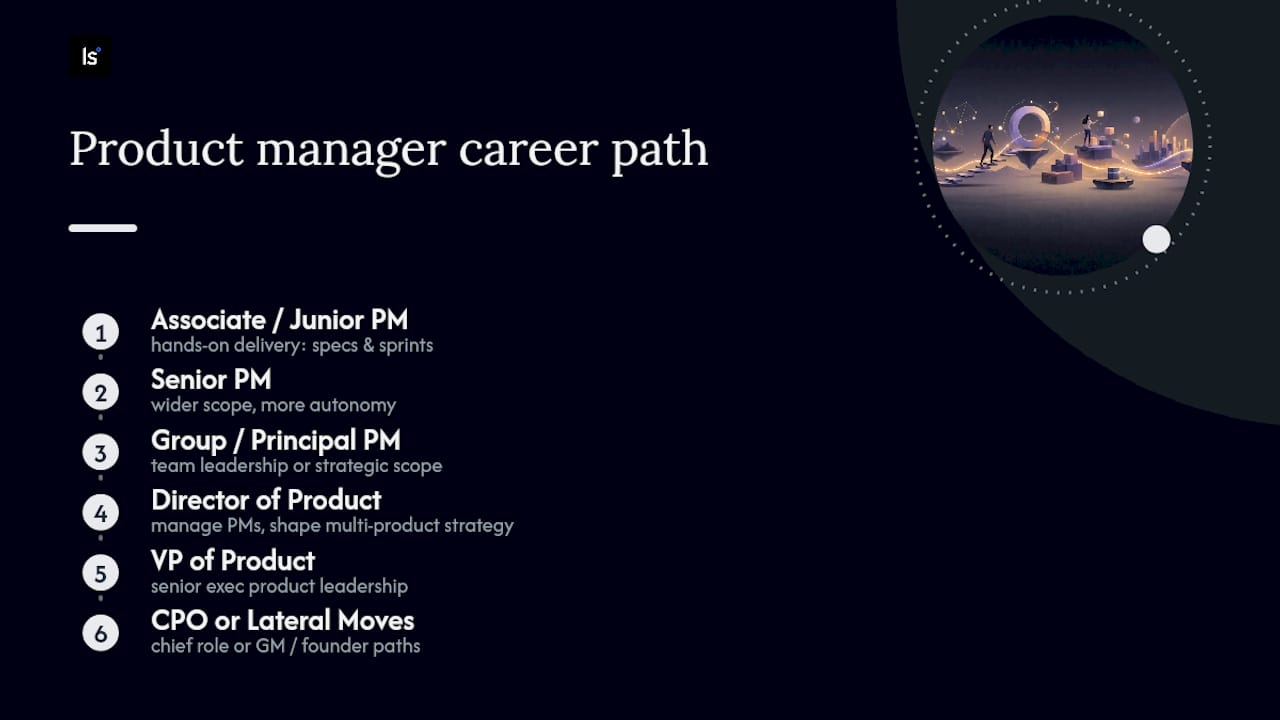
Most PMs start as an associate or junior product manager, often after a stint in engineering, design, consulting, or customer-facing roles where they picked up a working knowledge of the product. That first PM job usually involves heavy delivery work: writing specs, running sprint ceremonies, and building credibility with a single product line before earning wider scope.
From there, the path typically runs through senior PM, then group PM or principal PM, roles that add either team leadership or increased strategic scope without necessarily managing people. Director of product and VP of product come next for those who want to manage other PMs and shape multi-product strategy. Some PMs branch into chief product officer roles; others move sideways into general management or founder paths, since the skill set, balancing user needs against business viability, transfers directly to running a company.
Progression speed depends heavily on company size and stage. A fast-growing startup can push someone from associate PM to senior PM in two years out of necessity; a large enterprise might take twice that long but offers more structured mentorship along the way. Reading widely helps regardless of path, and a few foundational product management books tend to show up on nearly every experienced PM’s recommended list.
Three Priorities If You’re Starting Out as a PM
If you’re early in this career, skip the temptation to master every framework at once. Learn discovery and basic analytics first. Everything else, roadmapping, stakeholder politics, business cases, gets easier once you can tell a real problem from a loud opinion.
Then run small experiments and actually track the outcome. Not a big bet, a small one you can measure in weeks, not quarters. The habit of connecting a decision to a measurable result is what separates PMs who get trusted with bigger scope from those who don’t.
Finally, invest in relationships and writing clearly. Influence without authority is the whole job, and a crisp one-page spec earns more trust than a polished slide deck ever will.
Sources
Related articles


Get Started for Free
Join thousands of product people, building products with a sleek combination of qualitative and quantitative data.